The Journal · July 22, 2026
David Webb
Maison Profile
David Webb — American Boldness in Gold and Enamel
Where ancient motifs meet Manhattan swagger
Gold ripples like hammered sunlight. Enamel blazes in zebra stripes. Emerald eyes flash from the head of a golden frog. This is the world David Webb built—one where jewelry refuses to whisper.
Born in Asheville, North Carolina on July 2, 1925, Webb arrived in Manhattan with metalworking skills learned from his uncle and a vision that would reshape American jewelry design. In 1948, at twenty-three, he founded his eponymous house, which opened at 2 West 46th Street. The jewelry world would never be the same.
His heritage combines bold design, sumptuous materials, sophisticated craftsmanship, and a touch of cheekiness — making David Webb synonymous with the highest echelons of the bejeweled arts. Webb understood that American luxury needed its own language—less refined than European codes, more muscular, unafraid of drama.
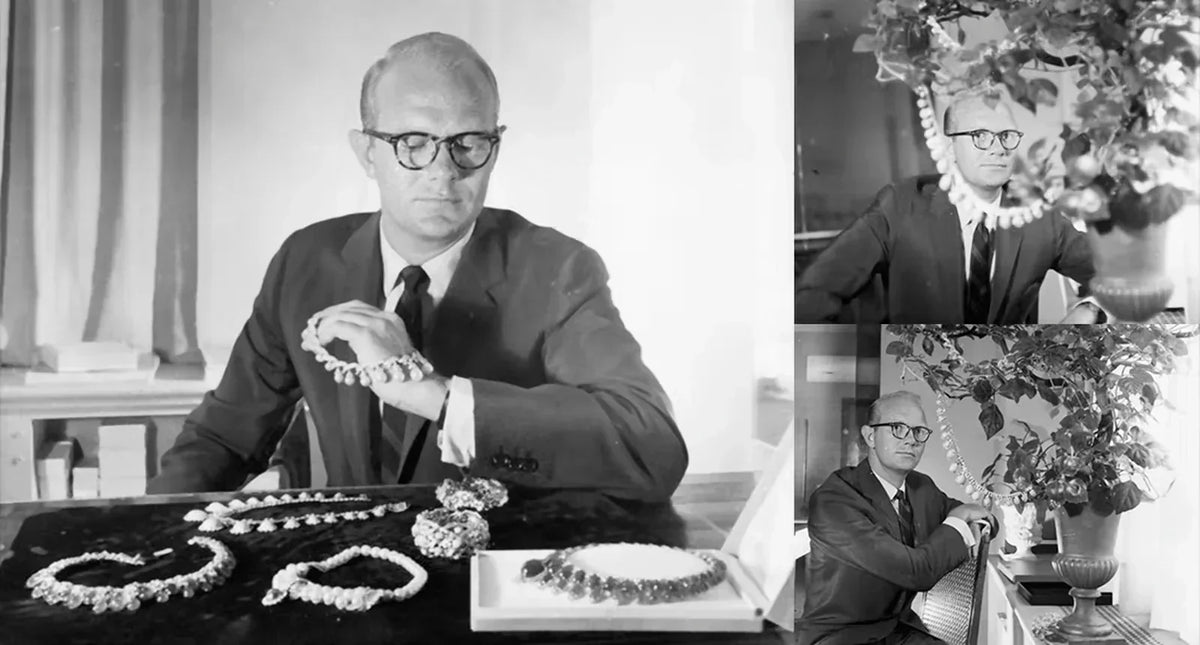
David Webb portrait. Image courtesy of David Webb.
The Making of a Master
After honing his skills at the Penland School of Craft in the Blue Ridge Mountains, Webb set his sights on New York City. David Webb spent the majority of the 1940s learning the trade on 47th Street, jeweler's row. But his real education came from the Metropolitan Museum, where he studied Etruscan granulation and Egyptian scarabs with the devotion of an archaeologist.
By the time he was 25, in 1950, Vogue came calling: the magazine featured a pair of Webb's earrings on its October cover.
He created his first animal bracelet in 1957. This bracelet was purchased by Elizabeth Taylor, who became a frequent client.
Through the 1960s, Webb established his distinctive design language—bold forms and richly textured gold inspired by diverse sources from Etruscan art to Art Deco. His personal library and frequent visits to the Metropolitan Museum of Art informed a design aesthetic that seamlessly blended ancient motifs with modern sensibilities. His most famous animal, the zebra, took shape in 1963; its stripes now form the company's logo.

Zebra ring. Photographed by Irving Penn for Vogue, 1964.
In 1964, David Webb won the Coty American Fashion Critics' Award for his animal jewelry — the highest accolade in American fashion — presented to him at the Metropolitan Museum of Art by Gloria Vanderbilt Cooper. It was the moment American jewelry declared independence from European precedent.
The Enamel Revolution
Webb's genius lay in his alchemy of materials. Where others saw gold as precious metal, he saw canvas. His hammered surfaces caught light like water. His enamel work—bold stripes, jungle spots, geometric patterns—transformed jewelry into portable art.
"Women are tired of jewelry-looking jewelry," Webb declared, and proceeded to create pieces that looked like nothing else on earth.
In March 1964, the Duke of Windsor bought his wife a surprise gift: a green enameled frog bangle. The Duchess loved it, and later received matching frog ear clips.

One of Webb's earliest animal designs, reflecting his personal fondness for frogs as a symbol of good luck. Photography by Ilan Rubin.
Among his clients were Elizabeth Taylor, Jacqueline Kennedy Onassis and Barbra Streisand. Other notable figures known for wearing David Webb's creations include Grace Kelly, Wallis Simpson (the Duchess of Windsor), Lee Radziwill, Lana Turner, Doris Duke, Gloria Vanderbilt, Nan Kempner, Ava Gardner, Leonore Annenberg, and Andy Warhol. Each piece Webb created was a statement of personal power, a refusal to disappear into the background.
The Collector's Eye
Webb died from pancreatic cancer on December 12, 1975, at just fifty years old, but his legacy blazes brighter than ever. Webb left behind an archive of over 40,000 original drawings and designs. Today, these sketches serve as blueprints for new creations, ensuring each Webb piece carries the maker's DNA.
Today, David Webb rings, necklaces, bracelets, earrings, and brooches continue to command top dollar at auction. Recent results demonstrate the market's continued appetite for his boldest statements: at Sotheby's High Jewelry sale on December 9, 2025, a David Webb nephrite, amethyst, ruby, and diamond "Demon Mask" necklace-brooch combination — from the Geri Brawerman Collection — sold for $508,000, more than sixteen times its high estimate of $30,000.

Nephrite, amethyst, ruby, and diamond, from the Geri Brawerman Collection. Sold for $508,000, Sotheby's, December 2025. Image courtesy of Sotheby's.
Provenance amplifies value at the highest levels. When Leonore Annenberg chose to mark her 90th birthday with a diamond of this magnitude, she trusted David Webb to set it — a milestone purchase entrusted to the house rather than to a European maison, telling in itself. The Annenberg Diamond, a 32.01-carat, D-color flawless stone mounted as a ring by David Webb, came to auction at Christie's in 2009 and sold for $7.7 million, a world-record price per carat for a colorless diamond at the time.

32.01-carat, D-color flawless diamond ring by David Webb, from the collection of Leonore Annenberg. Sold for $7.7 million, Christie's, 2009. Image courtesy of Christie's.
For the serious collector, Webb represents American luxury at its most confident. His pieces bridge the gap between fine jewelry and sculptural art, between historical reference and contemporary relevance. At Odeon, we recognize Webb's mastery of materials and proportion—the hallmarks of enduring design. His animal bracelets, particularly the zebra and frog variations, remain among the most sought-after examples of American jewelry craftsmanship.
Webb understood what few jewelers grasp: that luxury must have personality. His enamel work transforms precious metals into stories. His proportions declare themselves without apology. His use of color—emerald eyes on golden frogs, coral beaks on platinum birds—creates pieces that live in memory long after they leave the room.
In a world of whispered elegance, David Webb chose to roar.
Written by Olivia Aurtenechea
In the collection
David Webb pieces available now


A jewel in mind?
Looking for a particular piece? We find jewels for collectors every week.
The Journal


