Article: Zodiac: A 1970s Collecting Guide
Zodiac: A 1970s Collecting Guide
| Collecting Guide |
Fascination with the sky is not new to jewelry. The Victorians wore it first, decades before anyone divided the night into twelve houses. A star, in the language of the era, meant guidance — a fixed point to steer by. A crescent moon stood for the feminine, for a woman’s own turning phases, for change itself. Paired together on a honeymoon brooch, star and moon said what the era’s sentimental vocabulary of flowers and ribbons could not say outright. It was Queen Victoria’s own very public devotion, first to Prince Albert and then, for four decades, to his memory, that taught an empire to wear its private feeling in gold and diamond, pinned above the heart for anyone to read.

A Victorian star-and-crescent brooch. Odeon Archives.
A century later, the same appetite came back wearing a different name. By the early 1970s astrology had stopped being a parlor curiosity and become a genuine cultural fixture — horoscopes at the supermarket checkout, “Age of Aquarius” on the radio, “what’s your sign?” as the decade’s defining pickup line. Zodiac imagery sold vodka, ran through comic books, decorated jeans and jukeboxes and cocktail menus. Almost nothing escaped it. The great jewelry houses, never far behind a genuine cultural current, answered the only way they knew how: in gold.
Two Houses, Two Answers
Van Cleef & Arpels had worked with zodiac themes since the 1950s, but the idea reached its fullest expression through the 1970s, across pendants, long necklaces, bracelets, and even belt buckles — some in solid gold, others set in hardstone (malachite, lapis lazuli, sodalite), each keyed to a sign’s element. The signs turned up spelled out in gold letters as often as rendered as symbols. It’s a range the Maison’s recent “Cosmic Splendor” exhibition at the American Museum of Natural History, on Manhattan’s Upper West Side, showed in full — a 1972 Virgo pendant in gold, malachite, and diamond among the pieces on view, alongside a 1973 zodiac bracelet and a 1977 Cancer pendant.

Van Cleef & Arpels Aries pendant, 18k gold and malachite, with diamond accent. Odeon Archives.
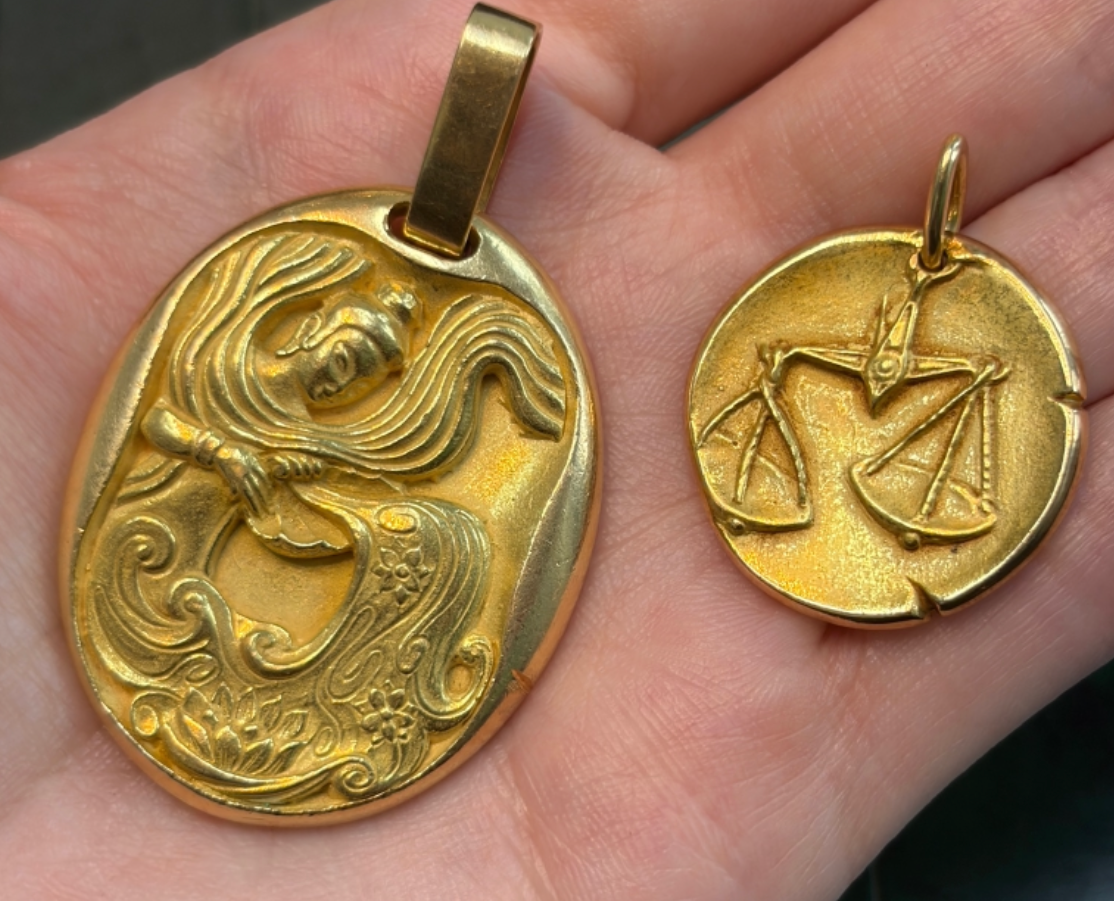
Cartier worked in gold alone, but ranged widely in scale. Its zodiac medallions came in more modest pendant sizes as well as rare, large-format pieces several inches across, a single sign filling the whole face in solid 18k gold — jewelry closer to sculpture than accessory, meant to be felt in the hand as much as seen. Both scales are rare and highly collected today — the smaller pendants for how naturally they wear, the larger medallions for their scale and presence. Van Cleef & Arpels’s and Cartier’s gold pendants from this period alike often carry a second mark beside their own: Georges Lenfant.
The Workshop Behind the Gold
The most collectible of these zodiac pieces were made by Lenfant — a name most of their original owners never knew.
The Lenfant workshop had been cutting gold for the great Parisian houses since before the First World War. Georges Lenfant was recognized as a chainmaster goldsmith for Cartier by 1909, and ran his own atelier at 47 rue des Petits-Champs, a few streets from Place Vendôme, from around that same period. His son, Jacques, joined the workshop in 1915 at the age of eleven, and later led it through what he called its Golden Years after the Second World War — the same period that produced pieces like these. The atelier supplied Cartier, Van Cleef & Arpels, Mellerio, Hermès, and Tiffany alike.

Van Cleef & Arpels zodiac medallions — Taurus, Cancer, Pisces, and Aquarius, 18k gold. Odeon Archives.
Under his mark, these pieces are genuinely hard to find. A collector set on a specific sign can spend months, sometimes years, before one turns up — and when it does, it commands a real premium. Prices have climbed sharply as more collectors learn to look for the Lenfant mark, a workshop’s signature turning out to matter nearly as much as the house’s own.
Why These Pieces, Now
The market has caught up to what these pieces always were. These were never meant to be rare in their day — zodiac jewelry was a very of-the-moment 1970s fashion, made in real quantity by both houses. What’s changed is the market around them: 1970s gold has become one of the categories collectors are actively chasing right now, and a piece carrying two signatures instead of one — a house’s name and a workshop’s maker’s mark together — commands a kind of attention a plain vintage pendant doesn’t.

Libra and Aquarius, layered on the chain — Van Cleef & Arpels and Cartier, both circa 1970. Odeon Archives.
The zodiac medallion sits at the center of two trends running at once. The first is yellow gold’s return, after a decade of quiet-luxury minimalism and platinum restraint — bold, worked, unmistakably gold jewelry is back on runways and in estate cases alike. The second is what the trade is calling the medallion moment: personal, symbolic pendants, worn stacked or layered rather than alone, the way Rihanna and Zoë Kravitz have popularized. Zodiac pieces sit naturally inside that trend, because they were built for it from the start — a sign is a small, specific piece of meaning, easy to mix with other gold on a chain.
We’re seeing this directly with our own clients: less interest in wearing the same thing everyone else is wearing, and a pull toward jewelry that says something specific about the person wearing it. Yellow gold over white. Pendants worn in twos and threes rather than a single statement piece. A birth sign, sometimes their own, sometimes a partner’s or a child’s, over the more generic language of a birthstone. A zodiac medallion does the same job a birthstone ring has always done, but in a form that reads as considered rather than default: chosen, not assigned.

Libra and Aquarius, reverse — Van Cleef & Arpels and Cartier, both circa 1970. Odeon Archives.
The ones that survive intact, particularly the larger and more sculptural examples, remain genuinely scarce. A piece carrying both a house’s signature and a workshop’s maker’s mark — Cartier and Lenfant together, say — carries two forms of authentication at once: the name the client knew, and the hand that actually did the work.
Written by Olivia Aurtenechea.

Leave a comment
This site is protected by hCaptcha and the hCaptcha Privacy Policy and Terms of Service apply.