The people behind Odeon · Hugo
The Riviera Light Is Different Everywhere Else
Three generations. One standard.
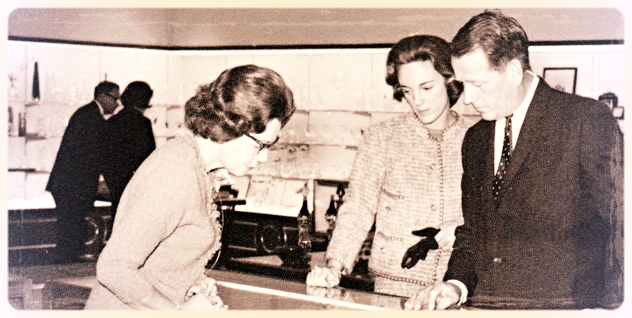
There is a photograph I carry in my mind of my grandfather at his desk in Juan-les-Pins, sometime in the early 1950s. I was not there — this was before my time — but the image has been described to me often enough that it has become memory by proxy.
His hands moving over an Art Deco piece. The particular quality of light on the Côte d'Azur, which is different from light anywhere else. The sense that what he was doing was not work so much as conversation — with the piece, with its maker, with whoever had worn it before.
That is how it began for our family.
And in some essential way, it is how it begins for me every morning still.
The Riviera, Three Generations Deep
My grandfather Edouard built the foundation. My father Hervé continued it, opening his jewelry store on the Rue de France in Nice. He had studied under the principals of the Scuola Benvenuto Cellini, the legendary Italian jewelry school — which gave him a standard of craft that he applied to everything he touched and demanded of everything he evaluated.
Growing up in that environment — Nice, the French Riviera, a family where jewelry was not a business but a way of seeing — meant absorbing things that cannot be taught directly. How to hold a piece. What weight tells you before light does. The difference between jewelry that was made to sell and jewelry that was made to last.
My grandfather could detect the latter at a distance.
My father refined the instinct further.
By the time it reached me, it was less a skill than an inheritance.
Art Deco as a First Love
My grandfather's particular passion was Art Deco, and it became mine too — not through instruction but through exposure, which is the only way aesthetic values actually transmit.
Art Deco jewelry is the most rigorous jewelry ever made. The geometry is unforgiving. The calibrated stones demand exactitude — a millimeter of variance destroys the logic of the whole. The platinum work of the great Parisian houses in the 1920s and 1930s represents an achievement in precision that the contemporary market has not surpassed and largely does not attempt. The economics no longer support it. The patience no longer exists for it.
But the pieces do. They exist in private collections and family estates, in the quiet networks that run between dealers across France and Europe. My grandfather believed that Art Deco would always hold its ground alongside modern and contemporary pieces — not as nostalgia, but as standard. A reminder of what jewelry looks like when it is done without compromise.
"He was right. Thirty years of working in this market have not given me a single reason to doubt him."
— Hugo Foutermann
From Nice to New York
Our family saw the opportunity to extend the business beyond the Riviera — first to London, then to New York, through our company HER Design & Co. New York is the right city for this work. It is a city that has always understood the value of European things brought with knowledge and care, and it is a city where the appetite for exceptional objects never exhausts itself.
When Benjamin and I founded Odeon Collection in 2014, we were bringing together two complementary inheritances. His: the instincts of someone who had learned the American estate trade from its foundations, who understood the market's mechanics and its appetite, who had an editorial eye for how objects move through the world. Mine: three generations of European expertise, a sourcing network built across France and Europe over decades, and a standard of evaluation inherited from men who had given their lives to understanding what makes a piece exceptional.
Fifty years of combined experience between two people is not the same as one person with fifty years of experience. The perspectives remain distinct. That is the point.
What Three Generations Teach You
People sometimes ask what it means to be a third-generation jeweler, as if the years themselves confer expertise. They do not. What they confer is a particular relationship to time — an understanding that the objects we work with have already outlasted most of the people who cared for them, and will outlast us too.
A piece of French jewelry from 1935 has survived a world war, several economic crises, the complete transformation of the luxury market, and the deaths of everyone who first knew it. It arrives in our hands with its integrity intact, its hallmarks legible, its craft undiminished. Our job is not to add to it. Our job is to understand it accurately and place it with someone who will continue its story responsibly.
That is the inheritance my grandfather left me. Not a business — a practice. A way of being in relation to objects that have already proven their durability.

Hervé, Hermine & Edouard Foutermann · Juan-les-Pins, France · 1951
The Riviera light is different from anywhere else.
But the eagle's head hallmarked into French jewelry
reads the same in New York as it does in Nice.
The knowledge travels.
The standard doesn't change.
The other half of Odeon
Benjamin
Read his storyThe House
Odeon Collection
Our story