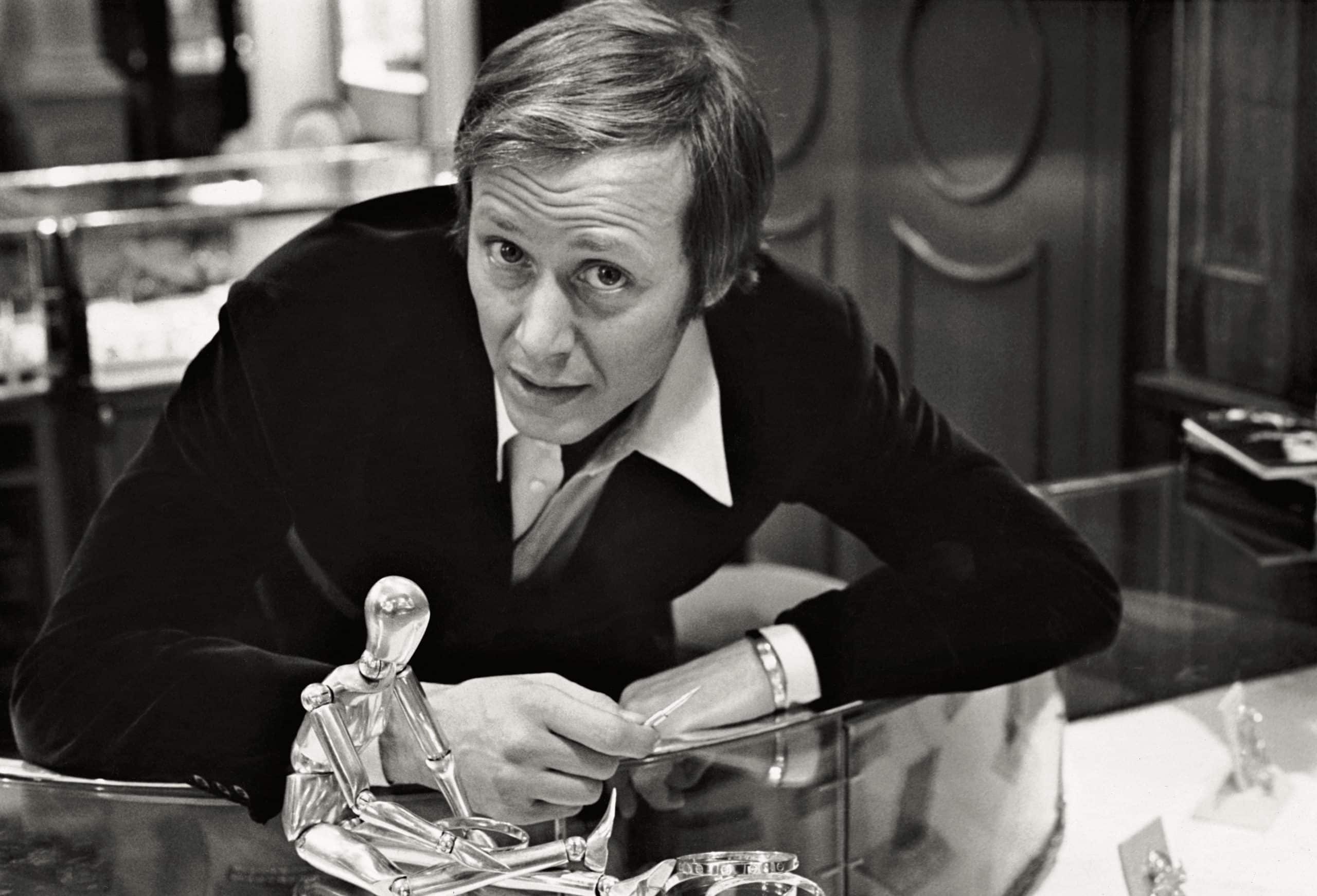
Aldo Cipullo
Aldo Cipullo — Love in Gold
Born in Naples, Aldo Cipullo was destined for gold. His father Giuseppe manufactured costume jewelry, and young Aldo began selling goods for the family business at fifteen. The apprenticeship in Rome's workshops taught him precision. The move to New York in 1959 taught him ambition.

Cipullo arrived in postwar Manhattan at precisely the right moment, navigating between the most prestigious jewelers on Fifth Avenue and 57th Street. His first stop was the workshop of David Webb, the mid-century favorite among the beau monde. Then Tiffany. By the early 1960s, he was designing Blue Book pieces, often using lapis, coral, turquoise — the colorful opaque gems that would become hallmarks of his work.
The Rejection That Changed Everything

The Love bracelet began, as many lasting things do, with heartbreak. After a relationship ended badly, Cipullo retreated to his studio in the small hours and sketched a bracelet that couldn't simply be slipped off — a jewel that required commitment to wear, and a screwdriver to remove. He wore a prototype on his own wrist while still at Tiffany. His colleagues admired it. The house was unmoved. They passed.
In 1969, Cipullo made the move to Cartier and pitched the design as his first project with the maison. Cartier's new management — the family had recently sold the New York branch to outside investors intent on younger blood — embraced it immediately. What Tiffany had declined became arguably the most recognized jewelry design of the twentieth century. By 2006, Cartier itself described the Love collection as the most successful in the maison's history.
"Design has to be part of function, that's the secret of success. When you have function and design, married together, you always have a successful item."
In 1971, he followed with "Juste Un Clou" — the Nail collection — twisting hardware into haute joaillerie. Cartier granted him the rare privilege of signing his pieces alongside the maison's name, a distinction shared with only one other designer in Cartier's history: Jean Dinh Van, who co-signed pieces produced through Cartier New York during the same era.
Cipullo left Cartier in 1974 to establish his own atelier, working independently while maintaining his winning streak with the maison. As a freelancer, he produced an award-winning men's collection and cheeky dollar sign jewelry, remarking that the symbol was "the electric eye that reflects the mood of this country."

An 18k gold Hamsa hand pendant by Aldo Cipullo, circa 1970s, designed as a protective amulet and set with approximately 7.5 carats of diamonds.
© Odeon Collection Archives
American Gemstones
In 1978, celebrating his adopted homeland, Cipullo was invited by the American Gem Society to create a collection using only gemstones native to the United States. The high-profile collection toured America and found permanent home in the Smithsonian. The thirty-one pieces utilized Montana sapphires, Arizona turquoise, and other native stones — a deliberate act of American pride from a man who had crossed the Atlantic with little more than ambition.
The Odeon Eye
For collectors seeking Cipullo's work today, the dual signature is everything. Pieces signed both "Cartier" and "A. Cipullo" — particularly early dated examples from 1969 to 1974 — command serious attention at auction. The market made this clear in December 2011, when Christie's offered a group of three Cipullo gold bangle bracelets from the collection of Elizabeth Taylor. Estimated at $1,500 to $2,000, they realized $98,500. Nearly fifty times the high estimate. Provenance, in the right hands, does not whisper.

His use of unusual stone combinations — onyx with amethyst, carnelian with lapis, rock crystal with gold — reflects his training in Rome's traditional workshops colliding with Manhattan's modernist sensibility. These are not decorative choices. They are positions.
Aldo Cipullo died in 1984 at forty-eight. Perhaps this explains his restless pace — perhaps it means Aldo remains forever young. His jewelry certainly does.
His legacy lives in gold that still speaks of love, still locks around wrists, still requires that sacred screwdriver.
Written by Olivia Aurtenechea



Leave a comment
This site is protected by hCaptcha and the hCaptcha Privacy Policy and Terms of Service apply.