Van Cleef & Arpels and the Art of Transformability
One Jewel, Many Lives
A jewel, in most houses, does one thing. It sits at the collar, or the wrist, or the ear, and it stays there. Van Cleef & Arpels never accepted that premise. For most of the twentieth century, the house treated transformability not as a novelty but as a discipline — a problem to be solved again and again, in gold, in gems, in clasps engineered to disappear entirely into the design.
The Zip
No piece captures that discipline better than the Zip necklace. The idea belonged to Renée Puissant, the house's Artistic Director and daughter of Alfred Van Cleef and Esther Arpels, who set out in the late 1930s to build a necklace inspired by an actual zipper — not evocative of one, but mechanically faithful to it. It took over a decade to make good on the idea. Metal does not want to behave like fabric; the teeth had to interlock cleanly, the pull had to glide, and none of it could compromise on wear. The original Zip necklace wasn't realized until 1950. Worn open, it is a necklace. Closed, it becomes a bracelet — the same jewel, entirely reconfigured, with no separate clasp or fastening required to make the transformation work.

The idea never stayed in the past. In 2005, Van Cleef introduced the Zip Couture necklace, a slimmer reinterpretation worn along the neckline or, in a nod to the design's utilitarian origins, sliding down the back. Since then the house has continued producing new versions inside its regular high jewelry output — the Zip Antique Orient in turquoise, coral, and pearl; the Zip Antique Rayon in yellow sapphires; the Zip Antique Origami in white diamonds alone. Seventy-five years on, it remains one of the only pieces in the house's history in continuous, evolving production, still built on the same premise Puissant set out to solve.
Passe-Partout and Hawaii
The house was solving a version of the same problem at the same moment, in a different register. The pieces that became the Hawaii collection were originally called "fleurettes" — small clustered flowers in rubies, sapphires, and diamonds — before taking the name Hawaii in December 1938. The following year, at the 1939 New York World's Fair, Van Cleef showed the Passe-Partout alongside them: a single jewel convertible between a necklace, a bracelet, a belt, or its own detachable clips. It stood, in that display, next to the Minaudière as one of the two inventions the house chose to represent itself to an American audience for the first time.
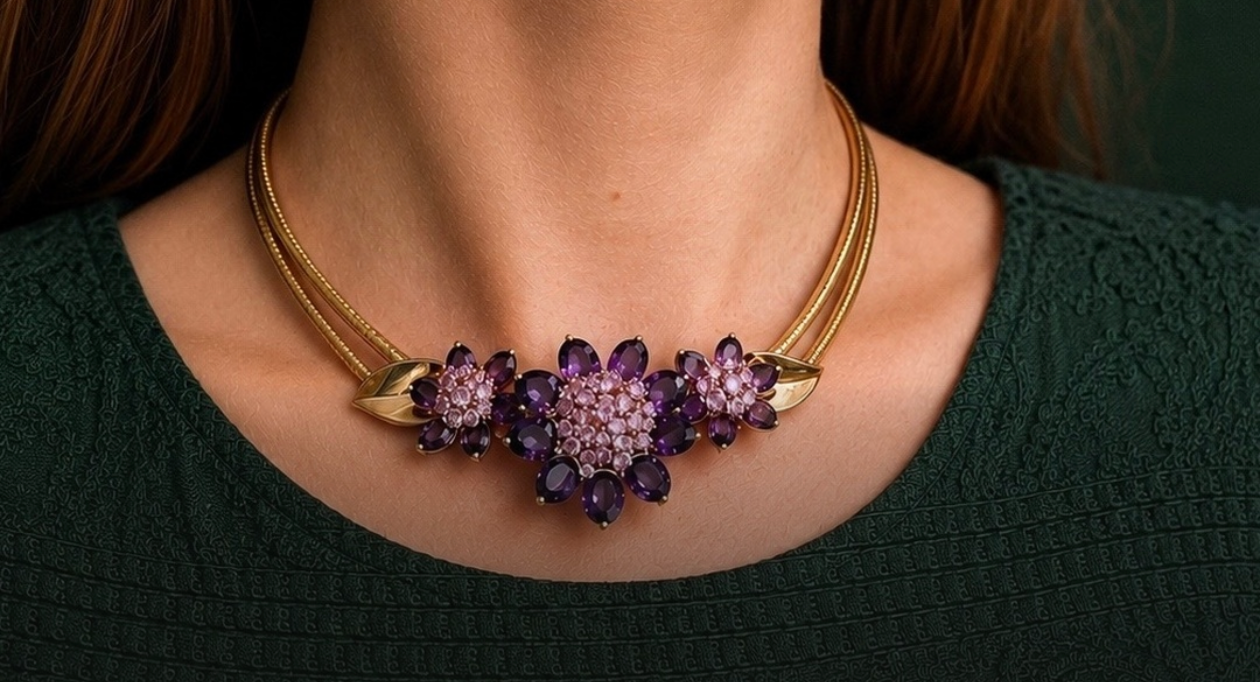
Van Cleef returned to this ground in 2025 with Fleurs d'Hawaï, a collection paying direct tribute to the 1938 originals, reworked in citrine, amethyst, rhodolite, aquamarine, and peridot. From our archives — a coiled gold necklace set with marquise-cut amethyst and pavé pink sapphire flowerheads.

Its center blossom detaches to be worn as a brooch. Its two outer flowers separate into a pair of earrings. Three configurations, one jewel, none of them incomplete without the others.

The 1970s Sautoirs
The house came back to convertibility with particular force in this same stretch of decades, when hammered gold and long chain sautoirs became their own laboratory for the idea. The Chevalerie demi-parure first appeared in 1969, and the house has continued producing pieces within the design since. From our archives — María Félix was photographed wearing Chevalerie bracelets stacked along the wrist, and, in a separate sitting, reconfigured as a belt at the waist.

An anchor sautoir works on the same principle. The pendant detaches on its own. The chain shortens into a shorter necklace or a choker, or separates entirely into as many as four individual bracelets — the anchor motif carried through every version, so the jewel never stops reading as itself no matter which form it's currently wearing.

The Delphe sautoir carried the same idea: eighteen-karat gold set with cabochon amethyst and coral, the piece is formed by five detachable bracelets and a removable pendant that doubles as a brooch — nearly forty inches of chain in total, wearable whole as a single sweeping sautoir, or entirely disassembled into its component parts, each one signed and numbered on its own.
Closing
What unites the Zip, the Passe-Partout, and every sautoir that followed is a standard the house never let itself relax. Every configuration had to feel complete on its own — never a fragment of something grander, never a piece waiting to be reassembled into its "real" form to make sense. A Chevalerie bracelet was never a demi-parure with pieces missing. A Delphe bracelet, worn alone, was never read as half a sautoir. Each version had to stand entirely on its own terms, engineered so thoroughly that its owner never felt she was wearing part of anything. That discipline, more than any single mechanism, is the real Van Cleef signature — and it's the reason these pieces still feel modern nearly a century after the house first set out to solve the problem.
Written by Olivia Aurtenechea Eguiron


Dejar un comentario
Este sitio está protegido por hCaptcha y se aplican la Política de privacidad de hCaptcha y los Términos del servicio.