
JAR
JAR — The True Connoisseur's Jeweler

JAR coral and amethyst earrings, Paris. Cabochon coral domes nested within pavé-set amethyst halos, in 18k blackened and yellow gold. 156 grams. From the Odeon Collection.
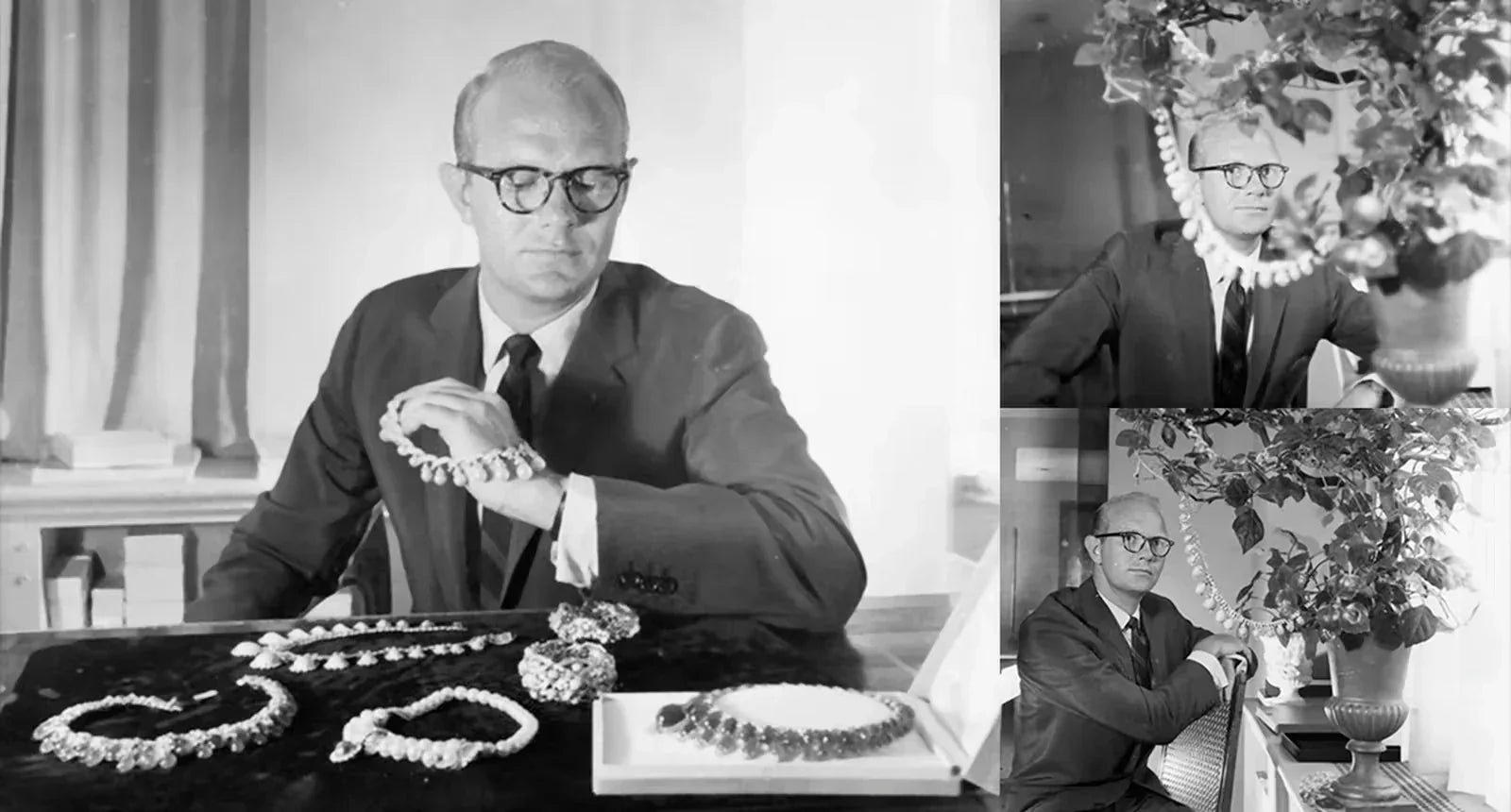
Ask a serious collector who JAR is, and the answer comes without hesitation. Ask almost anyone else, and it means nothing at all. That gap is not an accident — it is the point. Joel Arthur Rosenthal has never wanted to be known outside a small circle of people who already understood what they were looking at: billionaires, dynastic collectors, the handful of clients discerning enough to find him in the first place. He built a business by refusing the one thing every other maison chases — recognition beyond its own world.
There is no sign. No window display. No name on the black door at 7 Place Vendôme, tucked among the storied houses that spend fortunes announcing themselves. To enter, a client needs a personal introduction from someone JAR already trusts. Rosenthal has spent nearly five decades building a reputation on the principle that his work should be the only thing that speaks — and that the right people would always find their way to the door.
Born in the Bronx in 1943, the only child of a postal worker and a biology teacher, Rosenthal studied art history and philosophy at Harvard, graduating in 1966. Jewelry was nowhere in the plan.
The Needlepoint Years
He moved to Paris and tried on careers the way other people try on coats: screenwriting first, then a small needlepoint shop, where he painted his own canvases and experimented with unusual yarn colors no one else was using. The shop drew an unlikely clientele — designers from Hermès and Valentino among them — captivated by his eye for color before anyone thought to hand him a gemstone.
That happened almost by accident. A client asked if he could design a mount for a stone. He said yes, and never really stopped.
A brief stint followed as a salesman in Bulgari's New York store — his only formal jewelry training, and a short one. In 1977, he returned to Paris and began designing pieces of his own, working first with modest materials: coral, moonstone, small colored diamonds. Dealers, sensing something, would slip him an extra stone on consignment.
The Unmarked Door
That same year, Rosenthal opened his own atelier at 7 Place Vendôme with his partner, Pierre Jeannet, a Swiss psychiatrist who became his lifelong collaborator. He took his initials and made them the name: JAR, no periods, no elaboration.
The address placed him beside the oldest and grandest maisons in the world. Admission is by referral only, from a client JAR already trusts. Rosenthal produces perhaps seventy to eighty pieces a year, nearly all of them commissioned for a specific client and never repeated. He has been known to refuse a sale outright if he decides a piece isn't right for the buyer.

Poppy Brooch, 1982. Diamond, tourmalines, and gold. Private collection. Photograph by Katharina Faerber. Courtesy of JAR, Paris.
The JAR Aesthetic
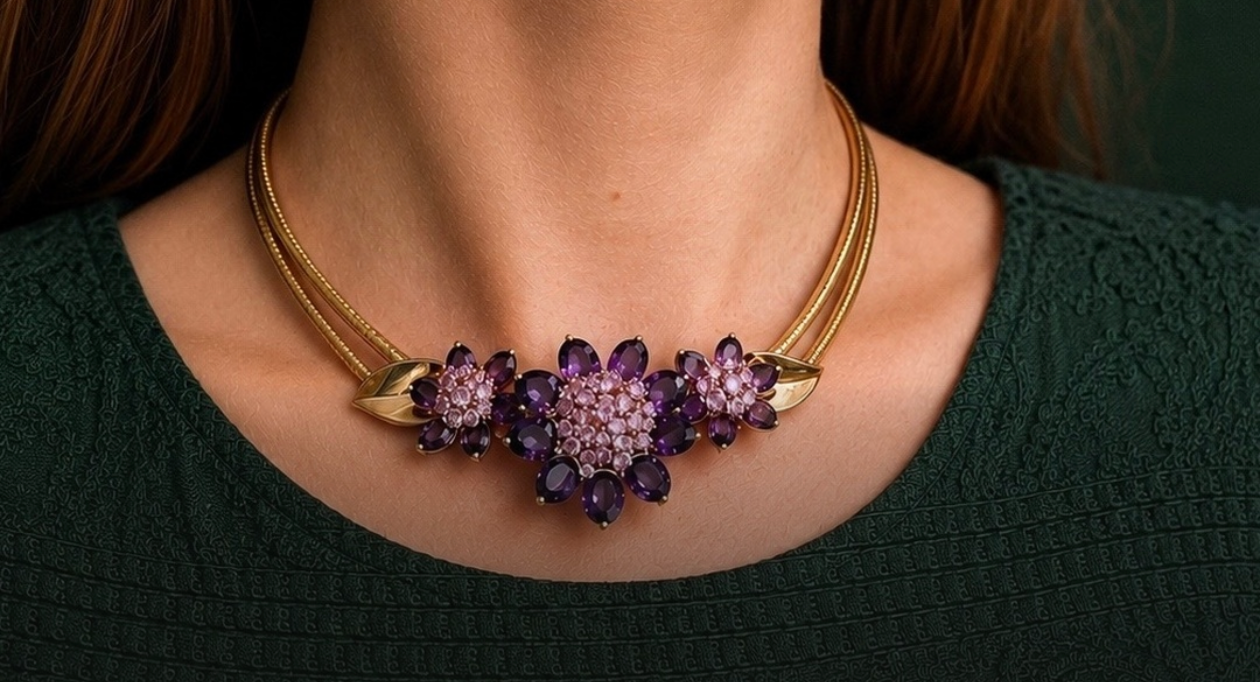
Rosenthal's signature is a pavé so fine it reads as brushwork rather than setting — tiny gemstones placed with the density of a needlepoint stitch, a discipline that traces back to that first Paris shop and its skeins of unusual color. He favors blackened metal beneath his stones, a setting choice that makes the color above it read brighter, deeper, more saturated than the same gem would look in platinum or gold.
His subjects come from the garden more often than the vault: pansies, gardenias, ivy leaves, raspberries, a leek brooch that turned a vegetable into high jewelry through sheer conviction. Color governs everything — Rosenthal builds each piece around a single, exact shade, mixing precious and semi-precious material without hierarchy, whatever that color demands.
Nothing in a JAR piece is quite as symmetrical as it first appears. A pair of ear clips from the collection of Lily Safra makes the point: one earring centers a 24.53-carat garnet, the other a 28.95-carat tourmaline, set in matching cuts and nearly matching size, so that at first glance the pair reads as a single, matched red. Look again and the difference declares itself — not identical stones at all, just two reds close enough to almost agree. It's the kind of near-symmetry found in nature rather than manufacturing, and part of why his work reads as sculpture before it reads as jewelry.

Garnet, tourmaline, amethyst, and diamond ear clips by JAR, 1995. From the collection of Lily Safra. Sold for CHF 207,000, Christie's, May 2012.
We've noticed the same subtle asymmetry closer to home. A pair of hydrangea earrings from our own collection pairs rose against violet rather than matching the two — two studies in the same flower, not a mirrored set. The choice reflects the same disregard for convention that runs through Rosenthal's use of material: he has never treated a substance's market value as a measure of its worth in a piece, and aluminum — cheap and industrial by every traditional standard — has appeared in his work as readily as gold or platinum. Our earrings are rendered entirely in colored aluminum, proof that the instinct holds as true today as it did when he first used it.

Hydrangea earrings by JAR, colored aluminum. From the Odeon Collection.
A Museum, Once
In 2002, four hundred pieces from private collections were shown at Somerset House in London, the lights kept deliberately low, visitors handed flashlights to find the jewels for themselves in the dark. As thanks to the clients who lent their pieces, Rosenthal made each of them a pansy brooch in colored aluminum. The pansy has been read as a JAR signature ever since.
But it was 2013 that changed how the world understood him, whether he wanted it to or not. The Metropolitan Museum of Art opened "Jewels by JAR" — over four hundred pieces spanning four decades, drawn largely from private collections that had never been seen in public. It remains, to date, the only exhibition the Met has ever devoted to a living jeweler. No other name in the history of the medium has been granted that distinction while still working. For a man who spent his career avoiding exactly this kind of exposure, the museum did what nothing else could: it confirmed, institutionally and permanently, what his clients had always known privately.

"Jewels by JAR" at the Metropolitan Museum of Art. Photograph by Suzanne DeChillo/The New York Times.
The Collector's Eye
JAR's rarity is structural, not marketed. With so few pieces made each year, and almost none repeated, a place on the primary client list is nearly impossible to secure — Rosenthal chooses his clients as much as they choose him. For most collectors, the only realistic path to owning his work is the secondary market, and that scarcity is precisely what drives it. A JAR piece at auction isn't simply rare; it is often the sole opportunity a buyer will ever have.

The Marie-Thérèse Pink, a historic JAR colored diamond ring. Sold for $14 million, Christie's, June 2025. Image courtesy of Christie's.
The results reflect it. At Christie's New York in June 2025, a JAR ring set with a 10.38-carat fancy purple-pink diamond — known as the Marie-Thérèse Pink — sold for $14 million, a new world auction record for a JAR jewel, and the highest price ever paid for a fancy purple-pink diamond. It more than tripled the previous JAR record: a ruby and diamond "Camelia" brooch, sold at Christie's Geneva in 2012 for $4.3 million.

Ruby flower brooch by JAR, known as "Camelia." Sold for $4.3 million, Christie's Geneva, 2012. Image courtesy of Christie's.
Smaller pieces perform with the same intensity relative to expectation. At Sotheby's in June 2025, an 8.62-carat emerald and diamond ring by JAR sold for $1.6 million against a high estimate of $700,000. That December, a reversible pink topaz pendant-brooch — unsigned, but authenticated by its original JAR case — brought $1,016,000.
For the collector who understands what they're looking at, a JAR piece is proof of a specific kind of trust: that Rosenthal decided, personally, that this stone and this client belonged together, and built accordingly. Nothing about the door on the Place Vendôme has ever tried to convince anyone otherwise. The work — and, now, the auction record — has always done that on its own.
Written by Olivia Aurtenechea

Dejar un comentario
Este sitio está protegido por hCaptcha y se aplican la Política de privacidad de hCaptcha y los Términos del servicio.