|
For most of the twentieth century, Oscar Heyman & Brothers made jewelry that carried other names. Cartier's. Van Cleef & Arpels'. Tiffany & Co.'s. The great maisons brought Heyman their most exacting commissions because its workshop could meet a standard they held for themselves and rarely found elsewhere — the trust ran in both directions, and it lasted decades. Heyman never needed its name on the piece to know what it had made.
The firm earned a title that says everything: "The Jewelers' Jeweler." It came from the trade itself, at the 1939 New York World's Fair, where Heyman's work filled the cases of four of the five retailers exhibiting in the House of Jewels — Cartier, Marcus & Co., Udall & Ballou, and Black, Starr & Frost-Gorham. Tiffany & Co., the fifth exhibitor, showed work from its own workshop that year, though it would go on to become one of Heyman's largest clients in its own right. One workshop. Four of five cases. The trade noticed.

The House of Jewels' own participant list from the 1939 fair, naming all five retailers.
|
Historical Foundations
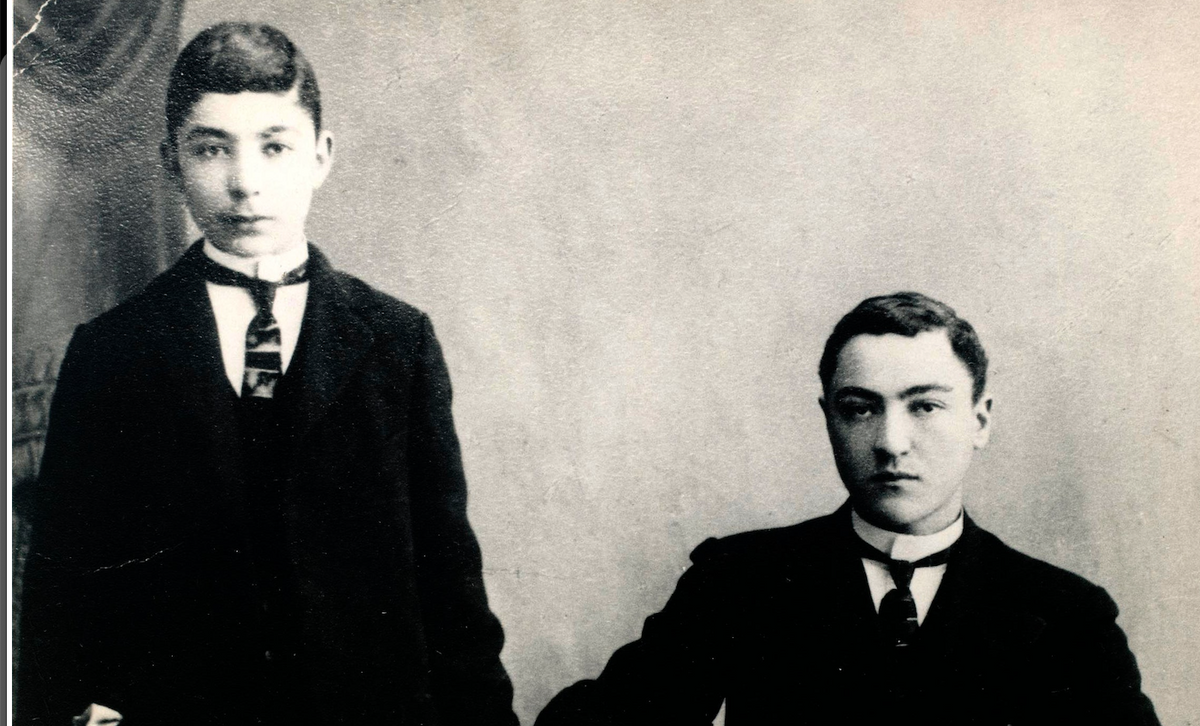
The Heyman family lived in Latvia, then under Russian control. As young men, Oscar and Nathan were sent to Kharkov, in what is now Ukraine, to train under a master jeweler who worked for the House of Fabergé. The apprenticeship gave them more than technique. It gave them platinum — a metal still rare and difficult to handle in 1906, when the brothers arrived in New York, and one that set them apart in a market that had not yet caught up to it.

Oscar and Nathan Heyman, before the brothers left for New York.
|
In 1909, Oscar took a position at Pierre Cartier's newly opened New York workshop at 712 Fifth Avenue — the first non-French bench jeweler hired at the House. It was an education in how the great houses operated, one he carried into his own business three years later.
Harry joined his brothers, and in 1912 the three founded Oscar Heyman & Brothers at 47 Maiden Lane, in the heart of the city's jewelry district. They opened as a trade supplier and stayed one by design, building a client list that came to include Black, Starr & Frost and E.M. Gattle in New York, Galt & Bros. in Washington, and J.E. Caldwell in Philadelphia. Three more brothers — Louis, William, and George — eventually joined the firm, six Heymans in total across the house's first half-century. Nathan, as gifted a toolmaker as goldsmith, filed the first of seven U.S. patents in 1916 — secure clasps, convertible mechanisms — engineering as exacting as anything the workshop set with stones.
The Art Deco Years
The 1920s were years of rapid growth, and Heyman benefited from the rise of Art Deco, a style that had emerged in France before crossing to the United States. The workshop answered with clean lines and bold color — sapphires, rubies, and emeralds set against geometric platinum and diamond frames, birds and animals rendered with a jeweler's precision. Cartier commissioned platinum mountings set with diamonds and precious stones for its wealthiest clients. Marcus & Co. and Tiffany & Co. followed, commissioning diamond and platinum rings that captured the spirit of the decade.
A Partnership Forged in the Depression
The Depression tested the firm like every other. Heyman adapted, developing more affordable pieces without lowering its standard for material or construction, while Oscar traveled to international exhibitions, studying the work of the Place Vendôme houses — Cartier, Boucheron, Van Cleef & Arpels. It was in these years that the relationship with Van Cleef & Arpels took shape. In the 1930s the French maison developed Serti Mystérieux, the invisible setting — a way of mounting stones with no metal visible at all — and needed a partner capable of executing it in America. Heyman had the precision the technique demanded and, over time, refined the manufacturing methods that gave the mysterious setting its durability as well as its seamless surface. The firm became Van Cleef & Arpels' exclusive workshop for pieces made using the technique, an arrangement that lasted until Richemont acquired the maison's majority interest in 2001.

A design drawing for a mystery-set flower brooch, in the invisible-setting technique Heyman helped perfect for Van Cleef & Arpels.
|
The War Years
The Second World War imposed real limits on the trade. Platinum, classified as a strategic metal, was requisitioned for military use, and jewelers across the country turned to gold and silver in its place. Heyman converted part of its workshop to precision manufacturing for the war effort; under Nathan Heyman's direction, the firm produced components for the Norden bombsight used in American bombers. It kept making jewelry throughout — flag brooches, pins honoring families with members in service, and other patriotic designs that found a ready public.
Postwar Revival
Peacetime brought flowers back. Heyman's pansy brooches from this era — platinum or gold, set in citrine, peridot, amethyst, diamond, emerald, and ruby — carry a message in the old language of flowers: pansy means think of me.
One surviving design drawing from the late 1940s, stamped with the firm's name and a stock number, shows an Argentine flag rendered in sapphires and diamonds, with a yellow diamond at its center cut in the shape of the "May Sun." The finished brooch carried a Van Cleef & Arpels signature. It was presented to Eva Perón, First Lady of Argentina, who wore it often enough that it became identified with her. Few pieces illustrate the arrangement as clearly: made in one workshop, sold under another maison's name, worn by one of the most photographed women of her era — its true authorship legible only to those who knew where to look.
Defining Aesthetic
No single decade defines Heyman's aesthetic, because the workshop never had one house style to protect. The Deco geometry of the 1920s gave way to the saturated color and inventive settings of the Depression years, worked through the technical discipline of Van Cleef & Arpels' invisible setting. Wartime scarcity turned the workshop toward gold and silver and patriotic themes. Postwar brought the pansy brooches' floral exuberance and, later, the increased scale of Retro gold. The firm moved with each era's fashion because its clients — a dozen different maisons, each with its own identity to protect — required it to.
What held constant underneath all of it was not a visual vocabulary but a standard. Gemstones sourced at origin. Metalwork executed entirely in-house, from alloying to finishing, at a time when most competitors divided that work among outside specialists. Every piece signed and, from mid-century onward, numbered against the firm's own records, regardless of whose name sat beside the signature. Nothing left the workshop that was not precisely what the workshop intended it to be. That discipline, indifferent to fashion and consistent across four generations of ownership, is what collectors and dealers still mean when they invoke the Heyman name today.

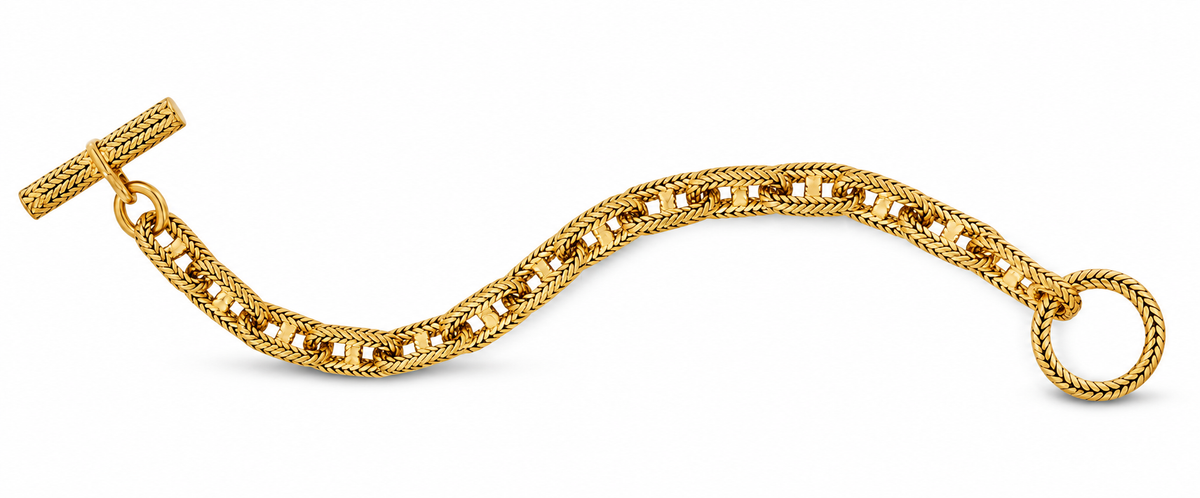
A range of Heyman bracelets, from geometric line work to carved gemstone motifs — the standard held constant across every style.
|
Marks & Verification
Because Heyman spent most of its history working under other names, identifying a piece takes more than a glance. Most examples made from the 1950s onward carry the firm's own "OHB" mark, stamped discreetly on the shank or the clasp. Earlier pieces rarely do. For jewelry made before mid-century, the more reliable signal is often the retailer's own name — Cartier, Marcus & Co., Bailey, Banks & Biddle, Shreve, Crump & Low, J.E. Caldwell. But the surest evidence is often not a mark at all. An expert, trained eye can recognize Heyman's signature craftsmanship on sight — in the precision of the gallery work, the way a stone is seated and finished on the reverse, the consistency of the metalwork from one piece to the next — regardless of whose name, if any, appears on it. Unstamped work still turns up regularly, and it still requires the same specialist authentication as anything else of consequence in this category.
This is, in practice, the same work Odeon does for every piece that comes through our doors: tracing construction, hallmarks, and stone origin back to a maker, whether or not that maker ever put its own name on the object. With Heyman, the effort is almost always worth it. A piece attributed correctly does not just gain a name. It gains a context — a workshop, a decade, a standard — that a generic attribution never could.
Hollywood and the Taylor-Burton Diamond
The 1950s put Heyman in direct contact with the movie business. In 1959, Laykin et Cie, one of the firm's Los Angeles retail partners, supplied more than a million dollars in jewelry for the film Imitation of Life, including pieces made by Heyman. Elizabeth Taylor became one of the house's most consistent wearers; Grace Kelly and Lana Turner wore it as well.
The relationship reached its height at the end of the decade that followed. When Richard Burton set out in 1969 to buy Elizabeth Taylor a 69.42-carat pear-shaped diamond being sold by Harry Winston, he was outbid at auction — by Cartier. Cartier agreed to sell the stone back to him on one condition: a brief display in its New York and Chicago boutiques first. The diamond, which became known as the Taylor-Burton, was initially set in a ring, but Taylor found it impractical to wear and asked Cartier for a necklace instead. Cartier's American representative, Kenneth Van Atten, brought the commission to Oscar Heyman, who designed a necklace strung with pear-shaped diamonds to showcase the stone. Taylor wore it to Princess Grace's fortieth birthday in Monte Carlo in 1969, and to the Academy Awards the following year.

Elizabeth Taylor wearing the Taylor-Burton diamond, set by Oscar Heyman.
|
Succession
In the 1950s, George Heyman began traveling personally to Bombay, Hong Kong, and Colombo to buy stones, establishing the direct relationships with gem dealers and mine owners the firm still relies on. The company marked its fiftieth anniversary on January 10, 1963, with more than two hundred guests.
Oscar Heyman died on July 13, 1970, at eighty-one, remembered in part for how he had treated retailers during the Depression, extending them credit and consigning jewelry so they could stay in business. Management passed to George, the youngest of the founding brothers, whose eye for gemstones made him the natural successor. Under George, and later under David Heyman, Harry's son, the firm expanded internationally through the 1970s — exhibiting at the Basel fair, entering Asian markets, producing a half-set for Queen Sirikit of Thailand — while Tiffany & Co. grew into one of its largest customers, placing orders for close to five hundred rings a month. Heyman's clientele by then included Frank Lloyd Wright, the Lauder family, and Mrs. Laurence Rockefeller — names that, true to form, rarely appeared next to Heyman's own.
Collector Relevance Today
The market has spoken clearly and repeatedly. At Bonhams New York in September 2024, a single-owner collection built substantially around Oscar Heyman jewels achieved nearly five million dollars, selling at 98 percent by lot and 100 percent by value. The top lot — an emerald and diamond ring centered on an 8.68-carat Colombian emerald flanked by step-cut trapezoid diamonds — sold for $508,500 against a pre-sale estimate of $250,000–350,000, more than doubling its low estimate. A "Birds in Flight" bracelet in the same sale more than doubled its own high estimate, closing at $203,700. Separately, a diamond ring set with a rectangular-cut 26.16-carat stone fetched $727,500 at Christie's in 2016, and an earlier Heyman "Birds in Flight" bracelet from 1925 brought CHF 1.4 million at Sotheby's Geneva in 2022. These are not sentimental premiums. They are the market's assessment of sustained quality in a category — signed and unsigned American Mid-Century fine jewelry alike — that has moved steadily upward for two decades.

A Heyman "Birds in Flight" bracelet — the design that brought CHF 1.4 million at Sotheby's Geneva in 2022.
|
At Odeon Collection, we encounter Heyman pieces regularly in the contexts we navigate every day: estate sales, European collections, American private holdings dispersed through the auction houses. What marks them, always, is a particular quality of resolve — in the metalwork, in the stone selection, in the construction of the clasp or the setting. These are objects built for the long duration. They arrive in our hands having survived fifty or seventy years of active wear and show it not at all. That is an argument for craft that no marketing language can replicate. Alongside the signed European maisons — the Cartier, Van Cleef, and Belperron pieces that form the core of what we carry — Heyman represents the American parallel: equally rigorous, equally committed, and, for now, still available at prices that serious collectors will one day look back on with satisfaction.
In 2017, the Museum of Fine Arts, Boston published "The Jewelers' Jeweler: Oscar Heyman," a monograph researched and issued by the museum itself, not a vanity publication. Among the pieces it holds is a brooch Heyman made for Marcus & Co. in the 1920s, its center a 60-carat emerald carved in India in the seventeenth century and bought in Bombay by an agent for Marcus & Co. Marjorie Merriweather Post owned it, wore it in two of her portraits, and kept it at the center of her jewelry for decades. It belongs to the museum's collection today. The institution recognized what the trade has always known. Some makers earn their place in history without ever needing to announce themselves. Oscar Heyman & Brothers is the clearest American example of that tradition.
The firm remains in Heyman hands. More than a century after Oscar, Nathan, and Harry opened their doors on Maiden Lane, their descendants still run a working atelier in New York, still draw on an archive built across four generations, and still make jewelry that carries names other than their own. The work was always the statement. Everything else was irrelevant.
|
Currently at Odeon
A 1963 Oscar Heyman platinum and diamond earring pair.
An Oscar Heyman diamond ring in 18k gold — five rows of channel-set square-cut diamonds, totaling approximately 4.98 carats.
|
Written by Olivia Aurtenechea
|


Laisser un commentaire
Ce site est protégé par hCaptcha, et la Politique de confidentialité et les Conditions de service de hCaptcha s’appliquent.