Article: How to Start a Jewelry Collection
How to Start a Jewelry Collection

From the Odeon Collection Archives
Jewelry, at its best, is always about meaning. Fine jewelry is a form of art and self-expression. Each piece carries a moment of creation inside it. To collect thoughtfully is to build a personal history, one jewel at a time.
The question most new collectors ask is: where do I begin? The honest answer: with knowledge, not money. The collector who understands what they are looking at will always outperform the collector who simply spends.
Building the Collection
Start with what's already yours. Your father's graduation watch. Your mother's wedding earrings. A ring passed down with a story attached to it. These pieces carry meaning collected pieces can't manufacture, and building around them from the start makes the collection unmistakably yours rather than a list of acquisitions anyone else could have made.
Consider adding a small Victorian piece to start with. The era offers a genuinely friendly price point for a first purchase — and it comes with a history as rich as anything you'll add later. Victorian jewelry was quietly, deliberately romantic. Acrostic rings spelled out sentiment in gemstones: a Diamond, Emerald, Amethyst, Ruby, Emerald, Sapphire, and Topaz set together to spell DEAREST; a Ruby, Emerald, Garnet, Amethyst, Ruby, and Diamond spelling REGARD. Snake motifs, popularized after Queen Victoria's own betrothal ring from Prince Albert took the same form, symbolized eternal love. Buckle rings carried their own quiet promise — being bound to someone, faithfully. These weren't decorative choices. They were how the era said things it wasn't always permitted to say aloud, and owning one now means owning a piece of that language.
Mix in your own story as you go, and keep mixing it. Don't confine yourself to one era, one house, or one metal — a grandmother's brooch sits naturally beside a Boucheron ring, and a piece of yellow gold beside a piece of platinum, if both are pieces you genuinely love. Your father's or grandfather's heavy, masculine watch can sit in the same collection as a dainty, feminine bracelet — the contrast is part of what makes it read as a life, not a look. The instinct to build a matched, uniform set is understandable, but it produces a collection that looks like everyone else's, assembled to a formula rather than a taste. Break that rule on purpose. A collection with real range — old beside new, warm metal beside cool, sentiment beside architecture — reads as considered rather than accidental, and it's the kind of collection that actually tells a story when someone asks about it. Your own eye, applied consistently over years, is worth more than any single "correct" way to build a set.
Beyond what's personal to you, there are a handful of classics every collection benefits from.
A gold bangle you can stack — the Bulgari Alveare bangle currently in our own collection is a good example of the type.

From the Odeon Collection Archives
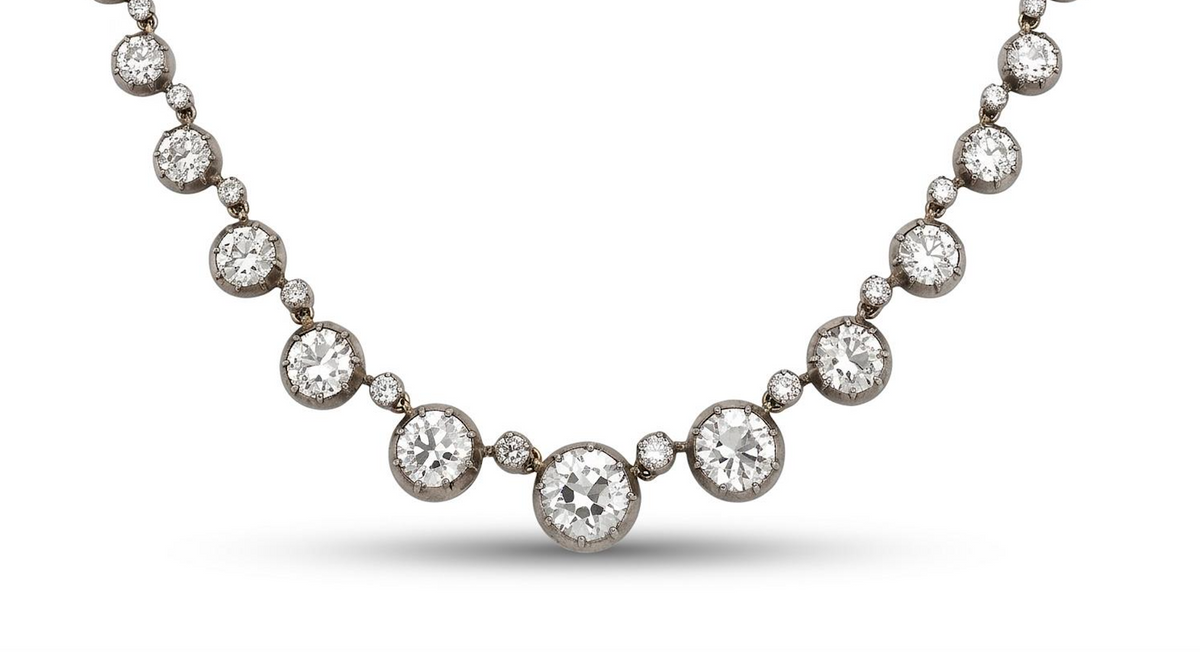
An antique diamond rivière, a single unbroken line of diamonds worn as a necklace.

From the Odeon Collection Archives
A diamond line bracelet — a related but separate classic, set with diamonds alone or combined with other stones, as in an Art Deco Tiffany & Co. example from our own archives.

From the Odeon Collection Archives
A pair of diamond studs, or dormeuse earrings — a genuinely antique style, dating to the late eighteenth and early nineteenth centuries, designed to be worn to sleep in so the piercing never closed. We have an example in our own collection.
And a pendant carrying real meaning — your birthstone, or your zodiac sign, or a loved one's. A piece like the Georges Lenfant "Virgo" pendant, made for Cartier and currently in our own collection, is exactly this kind of piece — a zodiac sign rendered in gold, worn by someone it was always meant for.
None of these need to arrive at once. They're a starting vocabulary, not a checklist — pieces you build toward and combine on your own terms.
Consider, too, building your own heirlooms deliberately — pieces you choose now specifically to pass down later, or that you personalize so they carry meaning before they ever change hands: a child's initials engraved inside a band, a private message hidden somewhere only the next owner will find it.
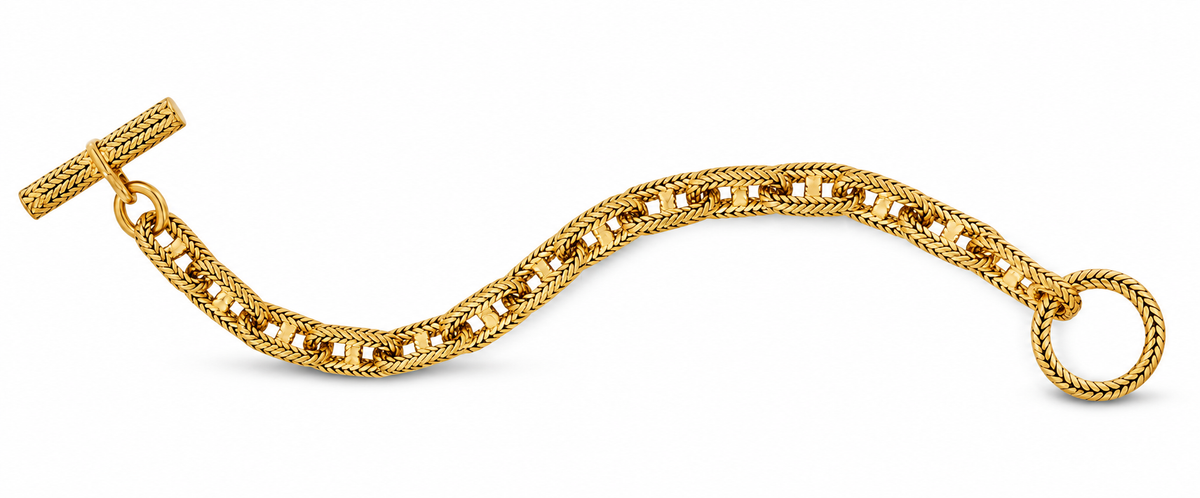
Condition is non-negotiable, and so is honesty about what you're buying. Quality over quantity, always — a smaller natural stone will outperform a larger one that's been heavily treated or heated, or one where clarity was sacrificed for size. Hallmarks matter enormously, and they need to make sense together: a French piece should carry French hallmarks — the eagle's head for 18-karat gold — alongside a legible maker's mark. A piece may carry both its house's mark and the workshop that actually crafted it — a Georges Lenfant "Chaîne d'Ancre" bracelet from our own archives, for instance, carries Lenfant's own maker's mark, distinct from the maison it was made for.

Georges Lenfant "Chaîne d'Ancre" Bracelet
From the Odeon Collection Archives |

Lenfant's Maker's Mark
From the Odeon Collection Archives |
An English piece should carry the lion passant and its own assay system. A piece whose hallmarks don't match its stated origin is a piece worth walking away from. Work with a trusted expert who can read these marks fluently — that relationship, more than any single purchase, is what protects a collection as it grows.
Houses Worth Knowing
As you build, a handful of names are worth learning to recognize by eye. Boucheron opened the first boutique on Place Vendôme in 1893, its client list reading like a registry of Europe's remaining thrones. Cartier followed the same pattern, earning the patronage of Princess Mathilde and the Empress Eugénie within a decade of its 1847 founding. Van Cleef & Arpels arrived in 1906 and, in 1933, patented the serti mystérieux — the Mystery Setting, where stones appear to float with no visible metal between them. Each house is its own design language: Cartier's Belle Époque garlands and Tutti Frutti exoticism, Van Cleef's transformable minaudières, Boucheron's early embrace of platinum and unconventional stones. Learn to read them, and jewelry starts to look different to you.
What a Signature Actually Means
A signature means value. It is authentication first — proof of the hand behind a piece — and, from the very start of this history, it has also been a driver of price and demand. We'd always say buy what you love first, but it's worth knowing plainly: a recognized name on a well-preserved piece tends to hold, and often grow, its value over time. Suzanne Belperron was known for refusing to sign her work —
— she said — and unsigned Belperron pieces still sell for hundreds of thousands of dollars at auction, recognized by eye and verified against her archive. JAR, by contrast, built his reputation on total privacy: no shop window, no advertising, perhaps seventy to eighty pieces a year from an atelier with no sign on the door — and in June 2025, a JAR ring sold at Christie's for $14 million, a world record for the house. The lesson in both cases is the same: the market rewards a name it can trust, whether that trust comes from a stamp or from a style nobody else could fake.
Know the Market
Sotheby's achieved $270 million in total jewelry sales in 2024. Signed jewels consistently outperform unsigned comparables — the market is telling you something, even if the reason you're buying is simply that you love the piece.
At the same time, the auction market is not the only market. Private dealers — specialists with deep relationships, deep stock, and deep expertise — access pieces that never reach the saleroom. Cartier clips from the 1940s. Van Cleef brooches with original receipts. Belperron rings authenticated against the archive. These pieces move quietly, between people who know what they are looking at. That is the world Odeon Collection inhabits, at 608 Fifth Avenue — fine and signed pieces from Cartier, Van Cleef & Arpels, Bulgari, JAR, David Webb, Boucheron, and Belperron, Victorian through Mid-Century, with the provenance documentation to match.
Written by Olivia Aurtenechea

Laisser un commentaire
Ce site est protégé par hCaptcha, et la Politique de confidentialité et les Conditions de service de hCaptcha s’appliquent.