Antique Diamonds Explained
Antique diamonds are having a real moment. In a world of machine-perfect stones, people are drawn to diamonds that could only ever be cut by hand — stones that read as unmistakably individual, no two ever quite alike.
The moment has a specific origin. When Taylor Swift's engagement ring from Travis Kelce was revealed in August 2025 — an elongated cushion-shaped old mine cut diamond, designed by Kindred Lubeck of Artifex Fine Jewelry and set in gold — searches for old-mine-cut diamonds spiked dramatically within hours, with reports of the increase ranging from several hundred percent to, by some accounts, several thousand. But the deeper pull isn't celebrity. It's a genuine appetite for individuality over uniformity. As one jewelry designer put it, people are looking for uniqueness as opposed to perfection.

A Short History of the Cut
The story runs through three distinct eras, each with its own name and its own dates.
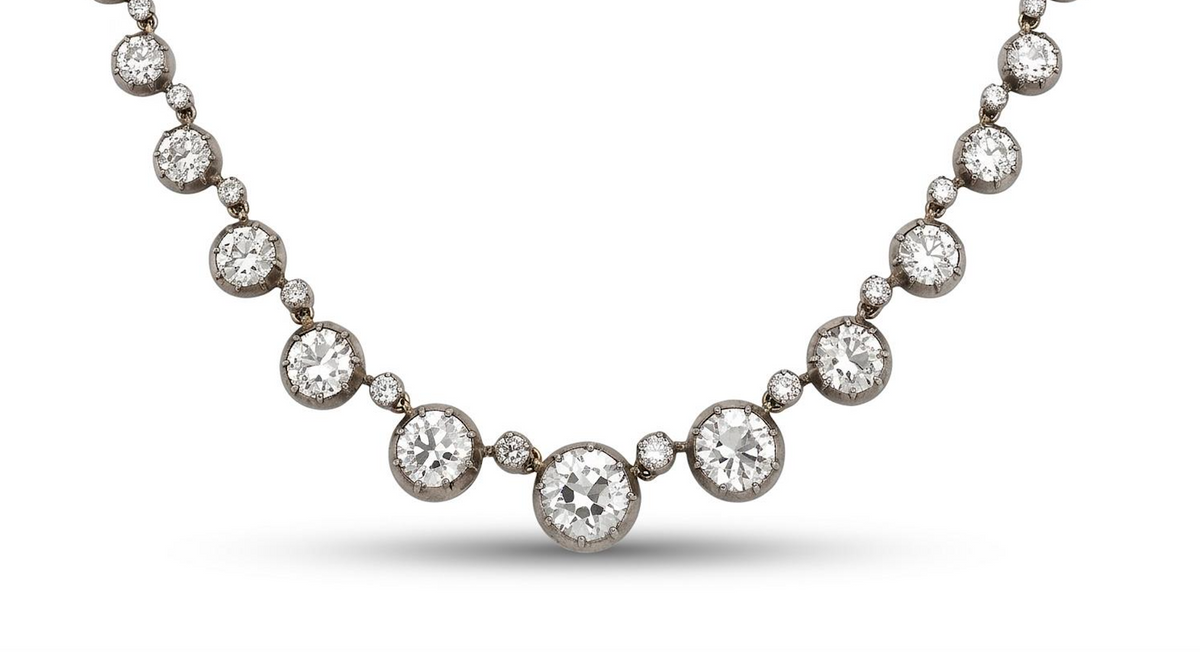
The old mine cut emerged in the early eighteenth century and dominated through the Georgian and Victorian periods, into the late 1800s. Its name has nothing to do with how it was faceted — it refers to where the rough diamonds came from. Before diamonds were discovered in South Africa in 1867, the world's diamonds came from older mines in Brazil and India, and stones cut from that rough became known simply as "old mine" stones. They're immediately recognizable by their cushion-shaped outline — a soft, rounded square rather than a true circle — with a small table, a high crown, and a large, deliberately open culet.

From the Odeon Collection Archives
The old European cut followed, emerging around 1890 and remaining current through about 1930, spanning the Edwardian era into Art Deco. It exists because of a single mechanical breakthrough: the bruting machine, introduced in the 1870s, which let cutters shape a diamond's girdle into a true circle for the first time. Before that, hand-shaping a perfectly round girdle simply wasn't practical, which is why every old mine cut carries that soft cushion outline instead. The old European cut kept the high crown and open culet of its predecessor, but traded the cushion shape for a rounder, more symmetrical outline — a genuine bridge between the old mine cut and the diamond shape we'd recognize today.
The break point is precise: in 1919, Marcel Tolkowsky published Diamond Design, the first mathematical analysis of how light actually behaves inside a cut diamond. His calculated ideal proportions — a 53% table, a 34.5° crown angle, a 40.75° pavilion angle — became the blueprint for the modern round brilliant, and they marked the definitive end of the old European cut era. It's also, not coincidentally, the moment the open culet disappears. A modern brilliant ends in a sharp point instead.
Reading the Difference
Once you know what to look for, the tell is immediate. Old mine and old European cuts have chunkier, bigger facets, cut by eye rather than machine — a higher crown, a smaller table, and that open culet: a flat 58th facet, absent from a modern brilliant, which ends instead in a sharp point. Old cutters believed that flat facet let more light into the stone. Look straight down through it, and you can appreciate the depth of the stone in a way a modern cut never quite shows you.

From the Odeon Collection Archives
None of this was arbitrary. These stones were cut to sparkle under candlelight, because candlelight was the only light there was. A modern brilliant is engineered for the even, bright light of a jewelry counter under electric bulbs. An old mine or old European cut was engineered for a much dimmer, warmer room, and it still performs best in exactly that kind of light today — a broad, warm flash of color rather than the sharp, contained sparkle of a modern stone.
The Setting Tells Its Own Story
The settings carry a matching history. These stones were frequently set in silver-topped gold — silver on the front to flatter the diamond's color against a white metal, gold on the back and the band to keep the silver from tarnishing against skin. It's a hallmark of the Victorian era, and a workaround for a problem that wouldn't be properly solved until platinum entered the picture. Platinum existed by then; jewelers simply didn't yet have the means to melt and work it. That took the invention of the oxyacetylene torch — a revolution in jewelry that deserves its own telling another time.
For now, the pieces speak for themselves: diamonds that were never meant to be perfect under fluorescent light, only unforgettable under a much softer one.

From the Odeon Collection Archives
Written by Olivia Aurtenechea

Laisser un commentaire
Ce site est protégé par hCaptcha, et la Politique de confidentialité et les Conditions de service de hCaptcha s’appliquent.