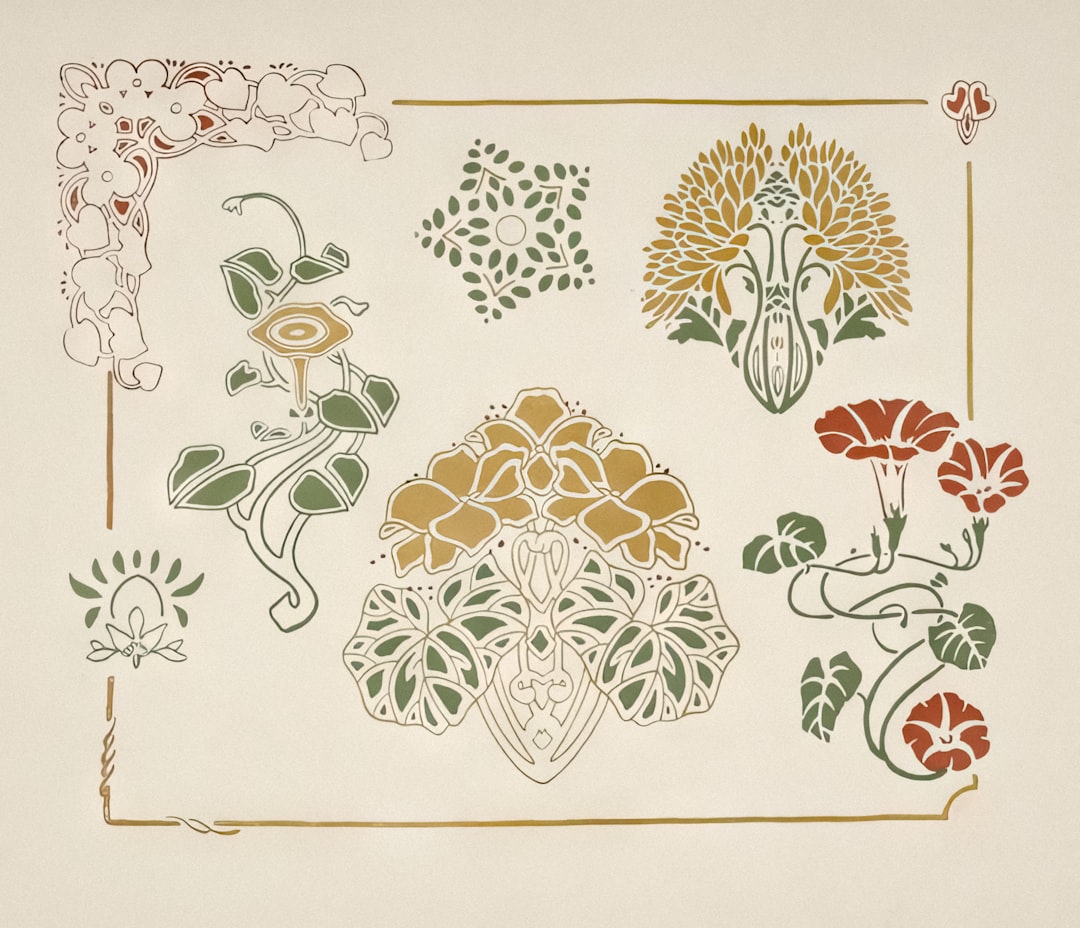

There is a brooch in our memory — and perhaps in your collection — that does not look like jewelry. It looks like a dragonfly caught mid-hover, its wings backlit by cathedral glass, its body a shifting opal. You do not wear it so much as release it. That is Art Nouveau. Not a style. A philosophy made wearable.
Its jewelers set out with a specific rebellion in mind: to strip value away from the mere weight of a stone and place it instead in conception, craft, and imagination. A carved horn pendant, worked by a master's hand, was to be worth more than an uncut diamond doing nothing but sitting heavy on a chain. Jewelry, in their eyes, was not a vault of intrinsic worth. It was art that happened to be wearable.
The movement lasted, in its truest expression, from roughly 1890 to 1910. Twenty years. Enough time to upend every convention of Western jewelry and leave a body of work that still commands rooms — and records — at every major auction house on earth. To understand it is to understand what happens when artists refuse the given vocabulary and go back to the source: the field, the forest, the moth at the lamp.
Historical FoundationsThe roots reach into the 1850s and eastward. When trade routes with Japan reopened in 1858 and Japanese artisans were invited to exhibit in London in 1862, a generation of European designers encountered something they had no name for yet: a design tradition that treated nature not as backdrop but as architecture. Japonisme, as it became known, gave Western craftsmen the antidote to Victorian fussiness — simplicity of form, intensity of color, the concept of mixed and humble materials used with total conviction.
Paris was the crucible. In 1895, the German art dealer Siegfried Bing opened his gallery on the Rue de Provence under the name L'Art Nouveau, and the movement had its banner. The 1900 Exposition Universelle was the apotheosis. René Lalique — born in 1860, trained first as a designer for Boucheron, Cartier, and Vever — exhibited there to international sensation. His pieces used horn, ivory, molded glass, and plique-à-jour enamel alongside precious stones, placing the beauty of material and craft above the mere weight of the gem. The diamond was no longer king. The dragonfly was.
Georges Fouquet, son of the jeweler Alphonse Fouquet who had founded the family house in 1860, pressed the movement into bolder, more architectural territory. In 1901, he commissioned the Czech artist Alphonse Mucha to design his new boutique on the Rue Royale — a complete Art Nouveau interior, now preserved in the Musée Carnavalet in Paris. Mucha also collaborated directly with Fouquet on jewels, most famously a coiled snake bracelet created for the actress Sarah Bernhardt: gold and enamel, serpentine and symbolic, designed to wind up the arm like something alive.

Snake Bracelet with Ring, 1899, designed by Alphonse Mucha for Georges Fouquet, created for Sarah Bernhardt. Image courtesy of the Mucha Foundation.
Defining AestheticThe grammar of Art Nouveau jewelry is consistent. Asymmetry over balance. Curve over line. Organism over geometry. Pieces were intentionally designed to suggest movement — a vine still growing, a wing caught in a gust, a woman's profile dissolving into petals. The natural world provided every motif: winding vines, blossoming orchids, dragonflies, peacocks, butterflies, and the elongated feminine figure rendered as nature incarnate.

Art Nouveau opal, diamond, and enamel "Cedars" pendant necklace by Georges Fouquet. Sold for CHF 480,500. Image courtesy of Christie's.
The technical ambition matched the visual program. Plique-à-jour enamel — in which colored enamel is suspended without a metal backing, open to light — created the effect of miniature stained glass on a lapel. The technique had existed since the Renaissance but was here taken to impossible refinement. Lucien Gaillard, working in Paris and deeply influenced by Japanese craft traditions, even recruited Japanese artisans trained in ivory painting and lacquer to execute pieces that European workshops could not. These were not decorative objects. They were competitive acts of craft.
Material choice was itself a statement. Art Nouveau jewelers employed horn, amber, jasper, carved glass, molded ivory, and semi-precious stones alongside gold and diamonds. This was deliberate. The traditional hierarchy of Western jewelry — value equals carat weight — was rejected in favor of a hierarchy of conception, execution, and beauty. A Lalique pendant in horn and enamel was worth more than a diamond brooch because Lalique made it so.
Collector Relevance TodayThe market confirms what connoisseurs have long known. At a Sotheby's sale that set the auction world talking, a René Lalique Art Nouveau enamel, diamond, and pearl pendant necklace sold for CHF 978,480 — more than seven times its high estimate of CHF 131,000, setting a new world auction record both for Art Nouveau jewelry and for any piece by Lalique. At the same sale, a Georges Fouquet pendant necklace sold for CHF 480,500, well above its estimate. These are not anomalies. Authentic Lalique jewelry pieces regularly reach six figures at auction, and the signed work of Fouquet, Vever, and Gaillard follows close behind.

René Lalique enamel, diamond, and pearl pendant necklace that sold for $978,480. Image courtesy of Christie's.
Signed pieces are the critical variable. Attribution — a documented maker's mark, a period poinçon, a stamped name on a rivet mechanism — can separate a piece worth thousands from one worth hundreds of thousands. Fouquet pieces, for instance, were typically stamped "G. Fouquet" on the setting hardware and "6 Rue Royale / Paris" inside original boxes. European hallmark knowledge is not a footnote in this market. It is the market.

The "LALIQUE" signature, viewed under magnification. From the Odeon Collection archives.
What drives the current appetite is partly scarcity and partly culture. These are handmade objects produced in a twenty-year window. They cannot be reproduced — only approximated. And in a collecting landscape grown weary of the generic, the organic forms of Art Nouveau speak with particular force. A dragonfly brooch in plique-à-jour carries everything the era believed: that beauty was a moral obligation, that nature was the superior designer, that the hand should follow the vine and not the ruler.
ClosingAt Odeon, we encounter Art Nouveau pieces with the care they demand. Hallmarks read under loupe. Enamel assessed in raking light. Provenance traced through European auction archives and private records. When a signed Lalique or Fouquet pendant crosses our desk — or a rare plique-à-jour brooch bearing a maker's poinçon consistent with a Paris atelier circa 1900 — we know what we are handling. So will you, in time. The pieces teach you. The dragonfly still hovers. The wing still glows. Twenty years of history on a pin's breadth of gold.
Written by Olivia Aurtenechea

Laisser un commentaire
Ce site est protégé par hCaptcha, et la Politique de confidentialité et les Conditions de service de hCaptcha s’appliquent.